» Summer 2020 .° ⊹
【 NASA L'SPACE Academy 】
˙˖ 𓏲 Lucy Student Pipeline Accelerator Competency Enabler ₊˳


「 ⠀⠀𝐓𝐄𝐀𝐌 𝟑𝟕: 𝑺𝒕𝒆𝒍𝒍𝒂𝒓 𝑳𝒊𝒈𝒉𝒕 ⠀⠀ 」
― 𝙰 𝙽𝚎𝚠 𝙷𝚘𝚙𝚎 ―
Disclaimer: A New Hope is not a real NASA mission.
Rather, it is a project for the NASA L'SPACE Mission Concept Academy Program.
_જ⁀➴ ⠀⠀⠀⠀⠀⠀FAQ:⠀⠀⠀⠀⠀⠀
Frequently Asked Questions:
| Q:⠀What is the NASA L'SPACE Academy? |
| A:⠀NASA L'SPACE Academy is a virtual program that provides unique hands-on learning experiences and insight from industry scientists and engineers. |
| Q:⠀What is the Lucy Mission? |
| A:⠀The 2021 Lucy Mission is to explore Jupiter's Trojan asteroids for the first time. Hopefully, this will bring more answers about the creation and evolution of our solar system. |
| Q:⠀What is Team 37: Stellar Light? |
| A:⠀We are a diverse team of highly motivated undergraduate STEM students from Southern California who are focused on learning more about space exploration. During the 12-week NASA L'SPACE Mission Concept Academy, we have developed a preliminary design review for a small rover based on science and landing objectives. |
| NOTE: |
| Special thanks to Sheri Klug Boonstra, Dann Garcia, our mentor Isabel Anchondo, and everyone behind the scenes of the NASA L'SPACE Program at Arizona State University for making this possible! |
●●●●●●●●●●
˗ˏ₊ __Mission Statement:__ ₊ˏ˗
to successfully land a secondary payload
onto Mars to collect and analyze samples
one meter deep from the Martian surface

⠀⠀⠀⠀⠀⠀Meet The Team⠀⠀⠀⠀⠀⠀
⠀Project Manager⠀⠀⠀⠀Project Deputy ⠀⠀⠀⠀Engineering Lead


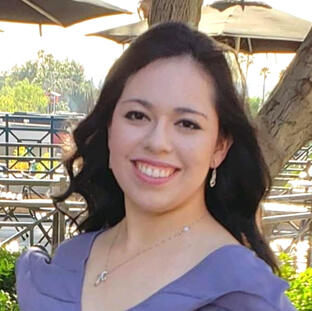
⠀⠀Andrew Diamond⠀⠀⠀⠀⠀⠀⠀Travis Crumption⠀⠀⠀⠀ ⠀⠀⠀Breann Garcia⠀ ⠀⠀
Andrew Diamond is a third-year Aerospace Engineering student attending California State Polytechnic University, Pomona. With experience in numerous hands on projects both on and off campus, Andrew hopes to expand on his knowledge in space mission development and planning.
Travis Crumpton is a third-year Physics student studying at the University of California, Riverside. He is dedicated and motivated to work in a program where he can use his management skills and education to help his teammates achieve their goal. As the Deputy Project Manager, Travis will work alongside the team to ensure progress is being made and success is achieved.
Breann Garcia is a rising senior at California State Polytechnic University, Pomona, majoring in Mechanical Engineering. Breann is passionate about space and has learned many valuable technical and leadership skills over the years from her academic group projects and extracurricular teams. She is now looking to share her experience as well as expand her technical knowledge while a part of this team.
⠀⠀Science Lead⠀⠀⠀⠀⠀⠀⠀Admin Lead ⠀⠀⠀⠀⠀⠀⠀⠀Engineer⠀⠀⠀⠀



⠀⠀⠀⠀Destiny Tsui⠀⠀⠀⠀⠀⠀⠀⠀⠀Sevada Avanessian⠀⠀⠀⠀⠀⠀⠀⠀Tony Shue⠀ ⠀⠀⠀
Destiny Tsui is a first-year Computer Science student at East Los Angeles College which is located in Monterey Park, California. In high school, she spent her summers eagerly learning in STEM programs, and she has continued this by learning in the NASA Community College Aerospace Scholars (NCAS) program at the Jet Propulsion Laboratory. As part of the science team, she hopes to conduct more research about how the rover’s instruments will help the mission on Mars.
Sevada Avanessian is a third-year Aerospace Engineering student at California State Polytechnic University, Pomona. Sevada is passionate about the aerospace field and hopes to gain hands-on experience in space mission design. With some technical experience and a multidisciplinary skillset, he hopes to expand his team's approach to this project.
Tony Shue is a third-year Mechanical Engineering student attending California State Polytechnic University, Pomona which is located in Pomona, California. He attended NCAS in September 2018 at Marshall Space Flight Center in Huntsville, Alabama and hopes to further develop himself in the tools needed to become a successful engineer.
⠀⠀⠀⠀Scientist⠀⠀⠀⠀⠀⠀⠀⠀⠀⠀⠀Admin ⠀⠀⠀⠀⠀⠀⠀⠀⠀⠀⠀Scientist⠀⠀⠀⠀


⠀⠀⠀Daniel Sandoval⠀⠀⠀⠀⠀⠀⠀⠀Gabriela Portillo⠀⠀⠀⠀⠀⠀⠀Dennis Tercero⠀⠀⠀
Daniel Sandoval is a senior Chemistry undergraduate student at California State University, Fullerton. Daniel’s interest in space exploration grew exponentially during his university studies, and he hopes to contribute towards it with his research experience. With technical research experience from an inorganic solid-state chemistry lab, he hopes to provide new perspectives about scientific experiments for the science team and gain some new skills along the way.
Gabriela Portillo is a first-year Aerospace Engineering student at Pasadena City College which is located in Pasadena. Gaby is a very determined person. During high school, she found her love for engineering during a summer program called Girls who code in which she acquired minimal coding skills, which she plans to develop in the future. She is also really passionate about mathematics and plans to make her team be the best by applying her mathematical knowledge when needed.
Dennis Tercero is a second-year Aerospace Engineering and Chemistry student at Pasadena City College, which is located in Pasadena. Although the pandemic has isolated everyone from school, he is still working in his Chemistry Research project at Cal State LA, which is “Design and Synthesis of Metal-Organic Framework Catalysts for the Degradation of Chemical Warfare Agents.” He hopes to connect both the engineering and chemistry aspects to this mission. Ultimately, he hopes to provide concise and efficient assistance to Stellar Light and learn new things from everyone in this group.
Brief Mission Overview:
⇢ Payload Objectives:
robotic drill to collect samples 1 meter deep
quarrying bid to transfer the sample to the MS-LIT instrument for analysis
6 wheels for the rover to allow maneuvering in the Martian terrain
MS-LIT, REMS, + camera data sent back to the International Space Station (ISS) via antenna
powered by plutonium decay, lithium ion batteries, + solar panels
⇢ Payload Success Criteria:
Upon arrival on the Martian surface, mission plans and rover communications begin immediately.
The mission will then be executed in a series of major steps which include:
allowing the rover to calibrate
communicating with mission control
transmitting data from onboard science instruments + camera footage
Only after this will HOPE begin its mission to drill into the Martian soil over the next several years.
Due to the length and duration of A New Hope, various mission criteria have been outlined below:
Mission Failure: HOPE unable to take any soil samples from any depth due to malfunction hardware, power supplies decline, or EDL failure. Failure to transmit science data, observation, or analysis to mission control.
Partial Mission Success: Science data, observation, and analysis able to be transmitted to mission control. At minimum, HOPE is able to take one soil sample at a depth from one meter using the onboard backup power supplied by lithium ion batteries.
Mission Success: HOPE is able to take 2 or more samples at a depth of one meter from more than one drilling site. Drilling sites are no closer than 100 linear meters. Science data, observation, and analysis are able to be transmitted to mission control.
⇢ Large Concept Payload Requirements:
The payload on board the Mars orbiter is a large concept which must fall under the:
volume constraint 61cm x 71cm x 96cm (24in x 28in x 38in)
mass constraint of 180 kg (400 lbs)
budget of $100M (100,000,000) or less
Separate 72 kilograms are allocated for the Entry, Descent, and Landing (EDL) System.*
⇢ Dimensioned CAD Drawing of Entire Assembly:
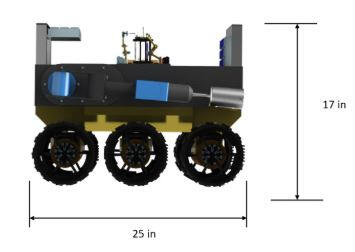
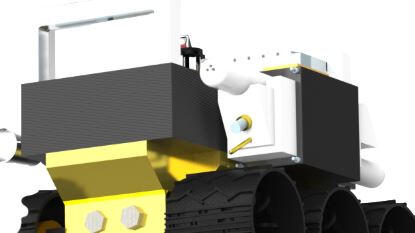
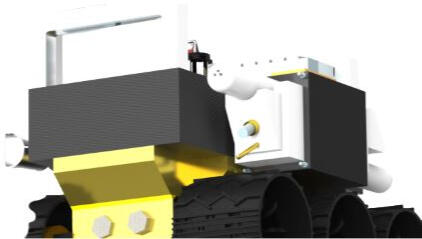
Figure 1: Front of HOPE. Figure 2: REMS on board HOPE.
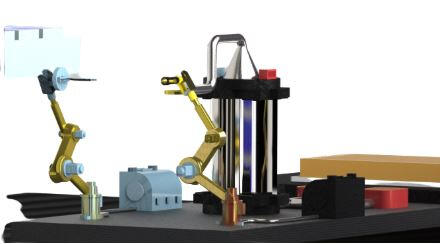
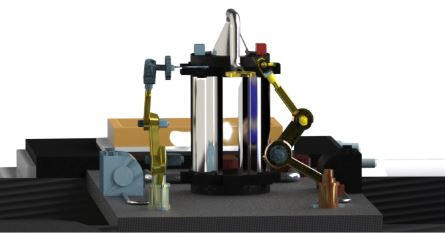
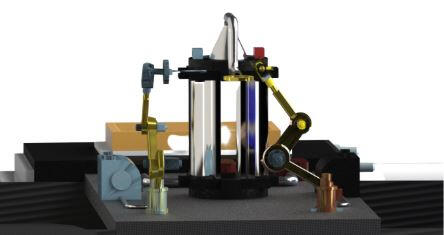
Figure 3: MOMA arms on board HOPE. Figure 4: MOMA on board HOPE (front view).
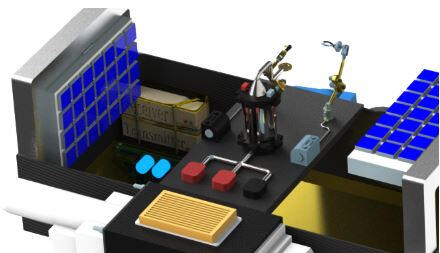
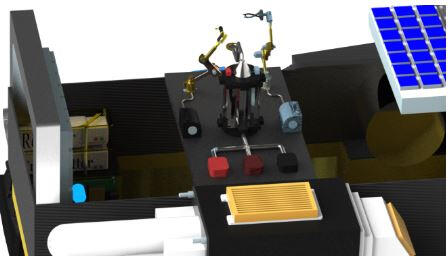
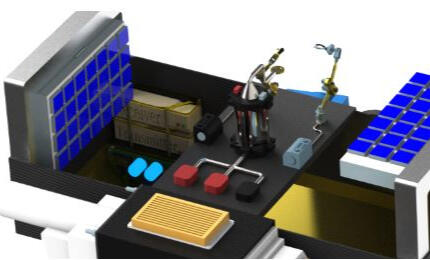
Figure 5: Undeployed solar panels and internal components. Figure 6: Second side view with MOMA.
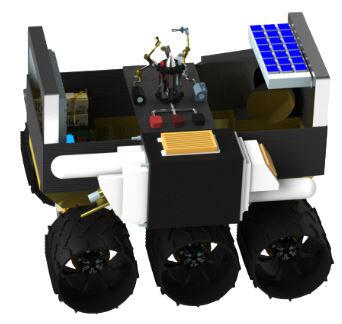
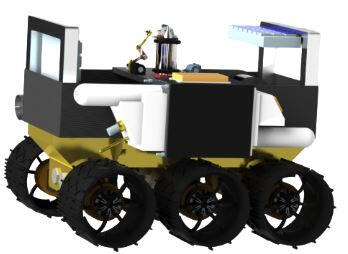
Figure 7: Left side of HOPE. Figure 8: Left side of HOPE (second view).
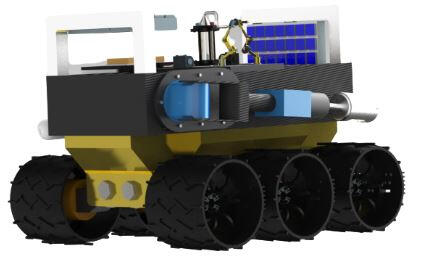
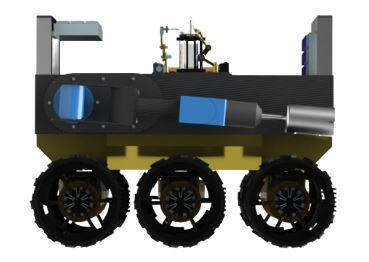
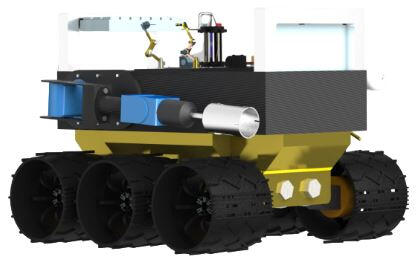
Figure 9: Back right side of HOPE. Figure 10: Right side of HOPE. Figure 11: Front right side of HOPE.
⇢ Concept of Operations &
⇢ Descent and Lander:

Figure 12: Concept of Operations Graphic
HOPE will separate from the orbiter 400 kilometers above the surface of Mars and descend into the Martian atmosphere with aerobraking being performed to bleed off the excess speed. Measurements from the MOMA will commence proper calibration as the lander approaches final descent. Once the rover has landed successfully, ground science research will commence. HOPE will collect soil samples from the Martian surface while transmitting the data gathered back for further scientific analysis.
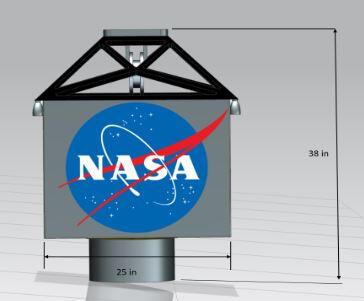
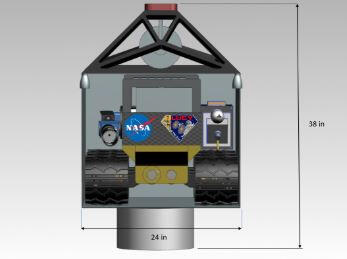
Figure 13: Complete EDL system (front). Figure 14: Complete EDL system (cross section).
HOPE will be parked in a 400 km orbit above the Martian surface with an orbital velocity of 3.362km/s.
After a deorbiting phase, HOPE attached to SkyCrane will begin a ballistic freefall for approximately eight seconds. Immediately following this freefall, a forward inflatable heat shield measuring 2.4 meters in diameter will be inflated to a fully deployed state.
This heat shield will dissipate up to ninety percent of the kinetic energy the system has, as well as shielding HOPE from superheated gasses due to friction upon entering the Martian atmosphere.]{#cbcbcb}
The rover will follow this ballistic path until 250 kilometers above the Martian surface.
At this point, the heat shield will be jettisoned from the descent structure, while simultaneously at a high speed, a thin atmosphere parachute will be deployed to further assist in reducing HOPE’s speed relative to Mars.
Parachutes will continue to guide HOPE on its descent until at 75 kilometers above the surface the parachutes will be jettisoned. After freefalling for approximately 15 kilometers, SkyCrane will begin to fire retro thrusters that will slow HOPE’s speed relative to Mars to just under 2 meters per second.
This downward velocity will remain constant until HOPE is released from the skycrane at approximately one meter above the Martian surface. After HOPE’s tether to the SkyCrane has been severed, SkyCrane will use the sparing fuel left in its tanks to safely fly away from the landing site at a 45 degree angle to ensure no obstructions due to the descent system will present issues in the mission.
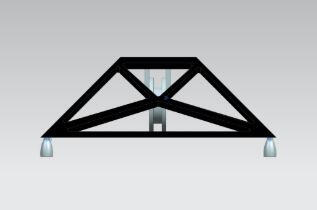
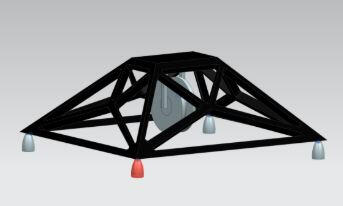
Figure 15: EDL System Front View. Figure 16: EDL System 3D View with highlighted thruster.
Post landing, HOPE will begin mission startup sequences which include transmitting data to mission control. This data includes science, camera/video feeds, + any onboard electronic measurement systems. Rover functionality and interfaces will be tested remotely by mission control, as well as testing various components on HOPE's infrastructure.
It is important to note, due to safety concerns with the power supply system, power generation must be measured and viewed as nominal prior to checking mission critical components outlined above. The reason for this is to ensure at least one sample is taken in case of a failure of HOPE’s power system.
Post mission startup and verifying all on board components + instruments are operating correctly, HOPE will begin its journey to drilling sites in order of most mission critical first. In order to minimize risk associated with HOPE failing while in route to drilling locations, locations closest to the landing site will be prioritized to minimize risk & prolong power supply.
⇢ Payload and Science Summary
There are two specific scientific goals for this mission and rover: to find water or signs that water once existed on Jezero Crater and being able to study different organic molecules to provide
a concrete resolution about life on Mars.
These two goals are accurately performed by the:
Mars Organic Molecule Analyzer (MOMA) ┈ which is a machine developed by the European Space Agency and the Russian Spacy Agency, with significant contributions from NASA. The MOMA instrument can detect a wide variety of small and large organic molecules, such as enzymes, lipids, and others. In particular, the MOMA-MS LIT (MOMA Mass Spectrometer Linear Ion Trap) instrument will be used to perform the Laser Desorption mode.
Rover Environmental Monitoring Station (REMS), which provides data about the weather surrounding the rover. The sensors on the REMS are able to detect changes and measurements about the wind, temperature, pressure, and humidity. With this information, it could teach scientists and engineers more about the present and future habitability conditions on Mars.
Upon reaching the drilling destination, HOPE will begin the sample and drilling sequences. This is a multistep process in which HOPE first allows batteries to reach a safe drilling level prior to drilling. This is a precaution taken to ensure the drilling operation does not fail due to low power levels from rover functions such as driving, camera systems, or any onboard electronics.
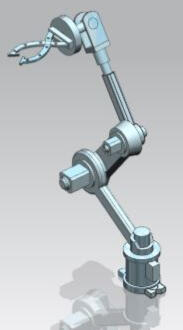
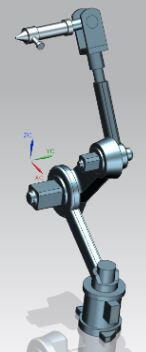
Figure 17: Robotic Arm #1 (left) will be used to take samples from the tip of the drill that will be in front of the MOMA-MS-LIT. Robotic Arm #1 is incorporated with a clamp to take these samples. These samples will then be placed on a metallic plate to further analysis. Figure 18: Robotic Arm #2 (right) will be used to vaporize samples once they are on the metallic plate of the MS-LIT machine. Robotic Arm #2 is incorporated with a high precision laser that will do the job described above.
Once reaching a safe battery level, HOPE will use the onboard drilling arm to first make contact with the Martian surface, and then drill approximately one meter into the Martian soil. After drilling and collecting the sample, the coring drill bit will be able to collect it.
An instrumental part of the Mars Organic Molecule Analyzer (MOMA) will be used to analyze the samples collected. To assist with this, a robotic arm, positioned on the MS-LIT (part of the whole MOMA) base, will take the sample from the tip of the drill and place it in a metal plate (similar to the watch plates used in chemistry labs) in front of the MS-LIT.
The heart of the MOMA mass spectrometer subsystem is a miniaturized linear ion trap (LIT) that supports two distinct modes of operation to detect: volatile and semi-volatile, low-to-moderate mass organics via pyrolysis coupled with gas chromatography mass spectrometry more refractory, moderate-to-high mass compounds via laser desorption (LDMS) at ambient Mars pressures.
Once the sample is in the metallic plate, a second robotic arm with a laser incorporated will vaporize the sample. Using Laser Desorption Mode, a beam of energetic light will concentrate its energy in a single spot that rapidly evaporates a portion of the sample releasing potential large organic molecules.]{#d0d0d0}
The laser shot also ionizes some of the molecules, allowing the vapor to head directly to the linear ion trap (LIT). For this part, a vacuum machine, placed on top of the MS-LIT, will be used to move the vapor from the metallic plate into the LIT.
This vacuum has two purposes, one is to absorb the vapor from the plate and head it to the LIT, and the other one is to eject neutral molecules before these reach the LIT, while the remaining ions are sent to the detector to determine their chemical makeup.
Laser desorption will enable MOMA to detect long molecules like lipids, the building blocks of cell membranes, and other organic molecules that then will be used to concretely conclude if life exists on Mars or if this once existed in this “dead planet.”
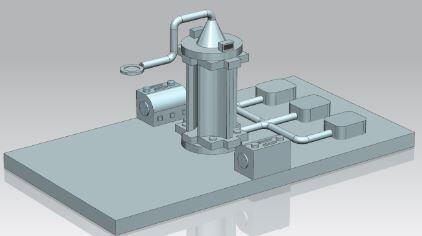
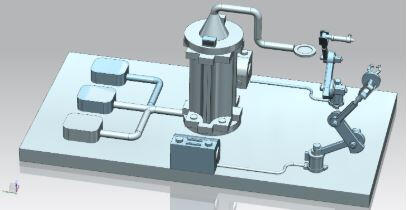
Figure 19: MOMA base plate. Figure 20: MOMA fully assembled.
Alongside the MOMA, the Rover Environmental Monitoring Station or REMS will be riding on board as well. The REMS consists of two “boom” shaped devices and a box-shaped deck device, all with their own important sensors and detectors.
The first boom, located on the side of the rover, facing the forward direction, contains a set of wind sensors located on the tip of the boom, a ground temperature sensor located below the boom, and an air temperature sensor located inside the body of the device.
Boom two is located on the same side of the rover as boom one but facing the opposite direction. Boom two contains a set of wind sensors on the end of the boom similar to boom one, a humidity sensor located below the boom, and the same air temperature sensor found in boom one as well.
The box-shaped detector located on the deck of the chassis will be used to detect UV radiation levels in the locations that HOPE travels to.
Finally, there will be a pressure sensor built into the chassis of the rover connected by a small filtered tube that will give information on atmospheric changes in the external environment.
The REMS is limited to operate in environments that are -130 °C to +70 °C to minimize power consumption. During operation, REMS will record five minutes of data at 1 HZ for each sensor, every hour of every day. This system will wake up, operate, store data, and shut down completely independently from the rest of the rover regardless of the rover's state of operation.
Designed to allow researchers up to 3 hours total of data collection each day, REMS enables pre-scheduled observation periods with a length of up to one extra hour to be designated by the science team to be available in order to maximize important data collection and unique event observation. Finally, if enabled, the REMS has implemented a simple algorithm allowing the rover to lengthen some of the regular observations in the event of unique atmospheric encounters.
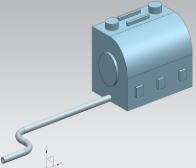
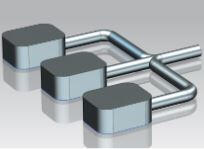
Figure 21: MOMA computers. Two centers of commands (computers) will be used to control both arms. One computer for each arm to avoid lag when dealing with the samples. These computers are connected directly to each arm and the MOMA machine for more precision once samples are ready on the plate. Figure 22: MOMA sample containment unit. Once a sample has been analyzed and its chemical composition has been determined, the main computer of the MOMA-MS-LIT will determine if this sample is high in value, and it will be stored in one of those three capsules. One capsule for lipids, one for enzymes, + the last one for other large organic molecules.
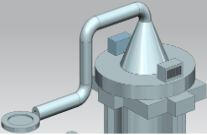
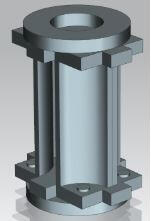
Figure 23: Vacuum systems and plate. Once the sensors of the metallic plate have been activated by a sample on it, the robotic arm with the laser will vaporize this sample, and the vacuum machine will turn on. This will send the molecules to the LIT, ionizing some and ejecting the molecules that will not be used or stored. Figure 24: MOMA LIT system. The LIT developed for MOMA-MS enables symmetrical ion injection pathways through the "top" and "bottom" of the hyperbolic rod subassembly, thus reducing space-charge effects and enhancing trapping efficiency. The heart of the MOMA mass spectrometer subsystem is a miniaturized linear ion trap (LIT) that supports two distinct modes of operation to detect.
⇢ Major Milestone Progression & Activity Plan:
| Task | Deadline |
|---|---|
| Mission Concept Review | 07/30/2018 |
| Systems Definition Review | 0/7/30/2018 |
| System Requirements Review | 7/30/2018 |
| Critical Design Review | 10/30/2019 |
| Systems Integration Review | 10/31/2019 |
| Mission Launch | 04/15/2021 |
| Mission Start | 10/15/2021 |
Deadlines set forward by project management allow ample time to develop a finished product and rigorous testing, as well as validation of mission expectations and outcomes with Failure Modes and Effects Analysis (FMEA) identified. While not listed, all aspects of rover, EDL, science, and mission have been considered and properly planned to ensure mission success. Should A New Hope be extended, budget, planning, and crew has been planned for and allotted for the opportunity to extend the mission.
⠀
The budget presented represents a large concept mission lander with a cost cap of $100 million. The budget presents the overall cost of the mission over a span of four years. This includes the salaries of nine employees, travel expenses to Cape Canaveral and the cost of manufacturing the payload including the EDL system, the rover and the heatshield. The budget also includes the cost of travel for testing the payload EDL system in various environments and locations. Due to the nature of this mission, the manufacturing of most of the components will have to be outsourced to companies like Aerojet Rocketdyne and Stadco who have manufactured mission components for NASA in the past. The outsourced manufacturing costs of the mission are represented in years one and two of the mission. The allotted cost for each year is $8 million.
⠀
Further mission support for HOPE and A New Hope is a potential additional mission and drilling extension to the already planned drilling sites. If granted the support to further explore the Martian surface, HOPE has the capability to travel to other drill sights. One proposed future drill sight is Midway. Midway offers valuable information into the history of Mars. Since HOPE is fully capable of being a nearly self-sufficient system and requires little to no maintenance and care once on the Martian surface, a mission extension to Midway is possible.
⠀
For now, the future of Stellar Light is preparing for Critical Design review. In order to ensure mission success and a successful CDR, the team at Stellar Light is working on manufacturing development of various components for tech demos and future prototypes. These demos and prototypes will be used in the mission development process for various testing procedures to ensure success for both HOPE and A New Hope altogether.
⠀
For any questions or more information, please feel free to reach out and send any of us a note on Linkedin!
last updated: 8/14/2020
by: Destiny Tsui